
A tractor battery looks like a small part.
But when it fails, the whole tractor stops.
For farmers, this is not just a mechanical issue. It can delay ploughing, spraying, harvesting, transport, and other important field work. One weak battery can waste time, fuel, labor, and even a full working day.
Many tractor battery problems can be avoided with simple care. The good thing is this: farmers do not need advanced technical knowledge to maintain a tractor battery properly.
They only need to know the warning signs, common causes, and basic daily checks.
This guide explains the most common tractor battery issues farmers face and how to reduce battery-related breakdowns in daily tractor use.
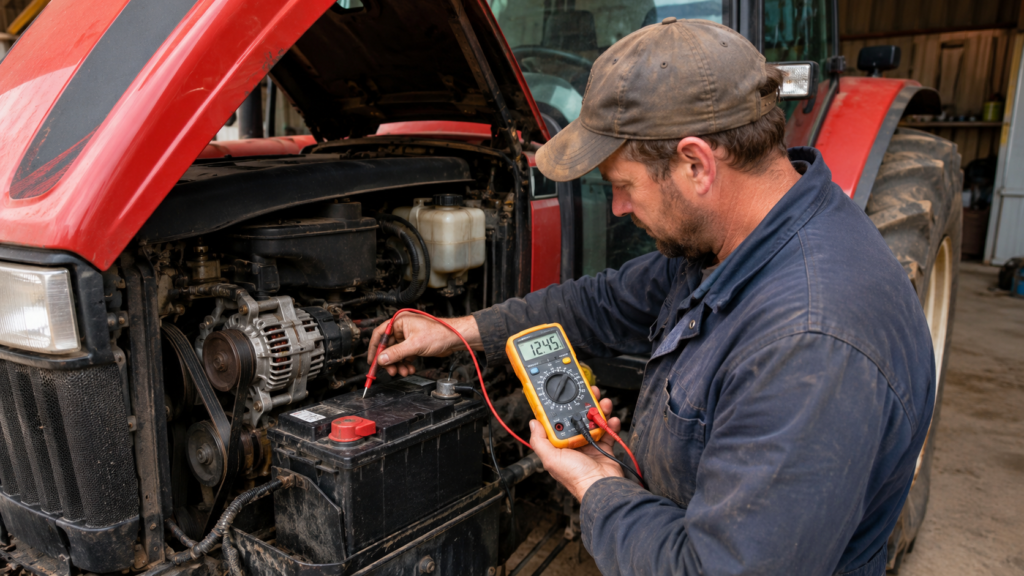
What Does a Tractor Battery Do?
The main job of a tractor battery is to provide power to start the engine.
But that is not the only job.
A tractor battery also supports:
- Starting system
- Headlights
- Indicators
- Dashboard meters
- Horn
- Electrical switches
- Other tractor electrical parts
If the battery is weak, the tractor may become difficult to start. Lights may become dim. Electrical parts may not work properly. In some cases, the tractor may stop responding completely.
So, battery care is not optional.
It is basic tractor care.
Common Tractor Battery Problems Farmers Face
1. Tractor Does Not Start
This is the most common battery-related issue.
The farmer turns the key, but the tractor does not start. Sometimes there is only a clicking sound. Sometimes the engine cranks very slowly. Sometimes dashboard lights become weak.
This problem can happen due to:
- Weak battery charge
- Dead battery
- Loose battery terminals
- Corrosion on battery terminals
- Faulty starter motor
- Alternator not charging properly
- Damaged battery cables
Before replacing the battery, farmers should first check the battery terminals, wiring, and charging system.
Many times, the battery is not fully dead. The real issue is a loose or dirty connection.
2. Battery Drains Quickly
Some farmers charge the battery, but after one or two days, the same problem comes back.
This means the battery is losing charge too fast.
Possible reasons include:
- Old battery
- Weak battery cells
- Lights left on after parking
- Electrical leakage
- Faulty alternator
- Loose fan belt
- Poor-quality battery
- Tractor parked for a long time
If the battery drains again and again, do not only charge it repeatedly. Check why it is draining.
Repeated charging without solving the main issue is like filling water in a leaking bucket.
It will not help for long.
3. Clicking Sound While Starting
A clicking sound during starting is a very common warning sign.
It usually means the battery does not have enough power to turn the starter motor properly.
Common causes:
- Low battery charge
- Loose terminal connection
- Corroded battery terminals
- Weak starter motor
- Damaged battery cable
Farmers should not ignore this sound. It is an early warning.
If checked early, the problem may be solved with simple cleaning or tightening.
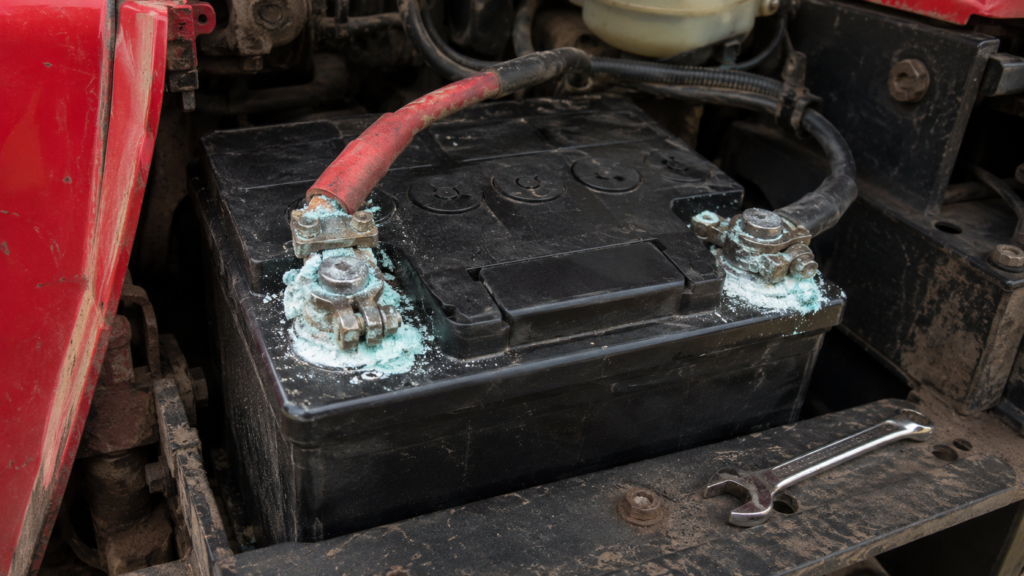
4. Corrosion on Battery Terminals
Battery terminal corrosion is a small-looking issue, but it can create big trouble.
Corrosion usually looks like white, green, or bluish powder around the battery terminals.
Because of corrosion:
- Current flow becomes weak
- Tractor starting becomes difficult
- Battery charging becomes poor
- Terminals may heat up
- Battery life may reduce
Farmers should regularly check battery terminals and keep them clean.
A dirty terminal can make a good battery act like a dead battery.
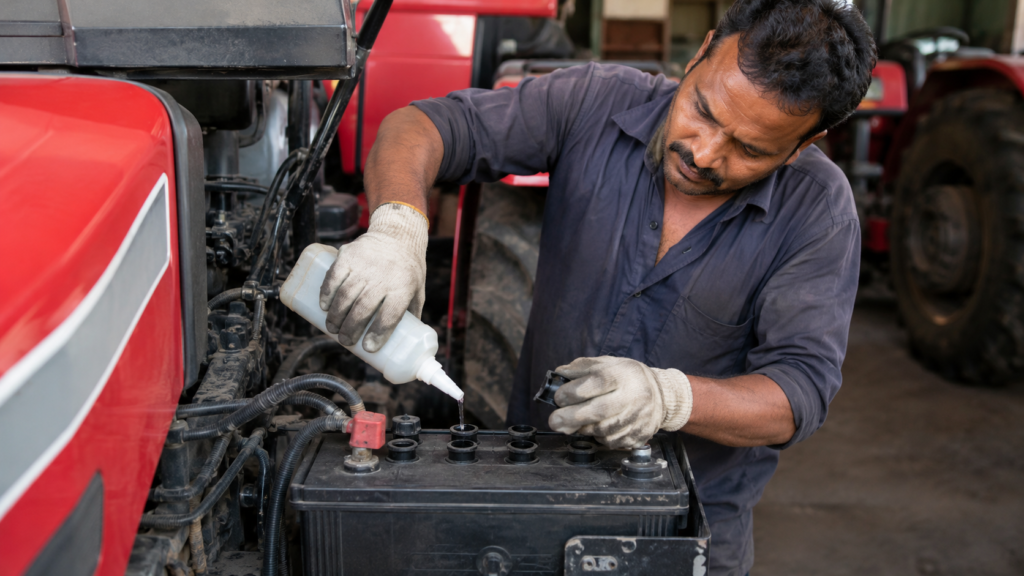
5. Low Battery Water Level
Many tractor batteries are lead-acid batteries. Some of them need water level checking.
If the water level becomes too low, the battery plates may get damaged. Once the plates are damaged, battery performance becomes weak.
Important tip:
Use only distilled water if the battery requires water topping.
Do not use normal tap water. Tap water may contain minerals that can damage the battery internally.
Also, never overfill the battery. Follow the correct level marking.
6. Battery Not Charging Properly
Sometimes the battery is fine, but the tractor charging system has a problem.
When the tractor engine is running, the alternator should charge the battery. If the alternator is weak or the belt is loose, the battery will not charge properly.
Warning signs include:
- Battery warning light on dashboard
- Battery becomes weak again after charging
- Lights become dim
- Tractor starts in the morning but struggles later
- Frequent need for external charging
Before buying a new battery, check the alternator and charging system.
This can save money.
7. Loose Battery Fitting
Tractors work in tough field conditions. Vibration is normal.
But if the battery is not fixed tightly, it will shake while the tractor is working. This shaking can damage the battery plates, terminals, casing, and wires.
Loose battery fitting can cause:
- Sudden starting problem
- Acid leakage
- Broken terminals
- Internal battery damage
- Short battery life
The battery should always be firmly fitted in its place.
No shaking.
No movement.
8. Wrong Battery Size
Some farmers use a smaller battery to save money.
But this can create more problems later.
A tractor needs strong starting power, especially for heavy-duty work, cold mornings, and repeated starting during field operations.
Using the wrong battery can cause:
- Hard starting
- Extra load on starter motor
- Short battery life
- Poor electrical performance
- Frequent breakdowns
Always use the recommended battery capacity for your tractor model.
Cheap wrong battery now can become expensive later.

9. Tractor Parked for Long Time
If a tractor is parked for many days or weeks, the battery may slowly lose charge.
This is common during off-season or when the tractor is not used daily.
Farmers can prevent this by:
- Starting the tractor regularly
- Running the engine for some time
- Disconnecting the battery if parked for long period
- Keeping battery area clean and dry
- Charging the battery before it becomes fully dead
A battery should not be left fully discharged for a long time. It can reduce battery life.
Warning Signs of a Weak Tractor Battery
Farmers should look for these signs:
- Engine cranks slowly
- Clicking sound while starting
- Headlights are dim
- Dashboard lights are weak
- Battery needs charging often
- Terminals are corroded
- Battery case is swollen
- Acid leakage is visible
- Tractor starts sometimes and fails sometimes
- Battery warning light appears
If these signs appear, the battery and charging system should be checked immediately.
Small warning signs are cheaper than big repairs.
Daily Battery Care Tips for Farmers
1. Check Battery Terminals
Look at the battery terminals regularly.
Make sure they are:
- Clean
- Tight
- Free from corrosion
- Properly connected
Loose terminals are one of the most common reasons for starting problems.
2. Keep the Battery Area Clean
Dust, mud, oil, and moisture can affect battery performance.
Keep the battery top clean and dry. This helps reduce electrical leakage and corrosion.
3. Check Water Level
If your tractor uses a serviceable battery, check the water level regularly.
Use only distilled water when required.
Never allow plates to remain dry.
4. Avoid Leaving Lights On
After parking the tractor, switch off:
- Headlights
- Indicators
- Work lights
- Ignition switch
- Other electrical accessories
This simple habit can prevent battery drain.
5. Start the Tractor Properly
Do not keep the starter engaged for too long.
If the tractor does not start, wait for a short time before trying again. Continuous starting attempts can heat the starter motor and drain the battery quickly.
6. Check the Alternator Belt
A loose or damaged alternator belt can reduce charging.
If the belt is loose, the alternator may not charge the battery properly. This can make the battery weak even if the battery itself is good.
7. Fix Battery Firmly
Make sure the battery is properly clamped.
Field vibration is already strong. Do not allow the battery to move freely.
8. Use Correct Battery Capacity
Always use the battery size recommended for your tractor.
If you are not sure, ask a tractor technician or parts supplier before buying.
Battery Care in Hot Weather
In hot weather, tractor batteries need extra attention.
Heat can increase water loss and reduce battery life.
Farmers should:
- Check battery water level more often
- Keep terminals clean
- Avoid overcharging
- Park tractor under shade when possible
- Check for swelling or leakage
- Keep battery area ventilated
Hot weather silently damages batteries. By the time the farmer notices, the battery may already be weak.
Battery Care in Cold Weather
Cold weather can make starting difficult.
A weak battery may work in normal weather but fail on a cold morning.
Farmers should:
- Keep battery fully charged
- Clean terminals before winter
- Use correct engine oil grade
- Avoid unnecessary lights before starting
- Check battery condition before cold season
Cold weather does not forgive weak batteries.
When Should Farmers Replace a Tractor Battery?
Battery replacement may be required if:
- Battery does not hold charge
- Battery drains quickly after charging
- Battery is very old
- Battery body is swollen
- Acid leakage is visible
- Battery fails load testing
- Tractor still has starting trouble after cleaning terminals and checking alternator
If the battery is old and weak, repeated charging is only a temporary solution.
Replacement is better.
Simple Tractor Battery Maintenance Checklist
Farmers can follow this simple checklist:
- Check battery terminals every week
- Clean corrosion when visible
- Tighten loose connections
- Check water level if battery is serviceable
- Use distilled water only
- Switch off lights after parking
- Check alternator charging if battery drains fast
- Keep battery properly clamped
- Do not use undersized battery
- Replace weak battery before peak farming season
This checklist can save time, money, and stress.
Final Advice for Farmers
A tractor battery is small, but its role is big.
Many tractor starting problems are not major engine problems. They are battery, cable, terminal, or charging issues.
Before blaming the tractor, check the battery first.
Regular battery care helps farmers avoid sudden breakdowns, starting trouble, and unnecessary delays in field work.
For farmers, the best tractor is not only the one with strong horsepower. It is the one that is ready when the work starts.
And that readiness begins with simple maintenance.
Need Support for Tractor Selection or Spare Parts?
AGRIPAK Group supplies export-version tractors and agricultural machinery for farmers, dealers, and importers.
For tractor inquiries, spare parts, and export support:
AGRIPAK Group
Website: www.agripakgroup.com
Email: mrkt@agripakgroup.com
WhatsApp: +971 50 925 6216 / +971544250361