
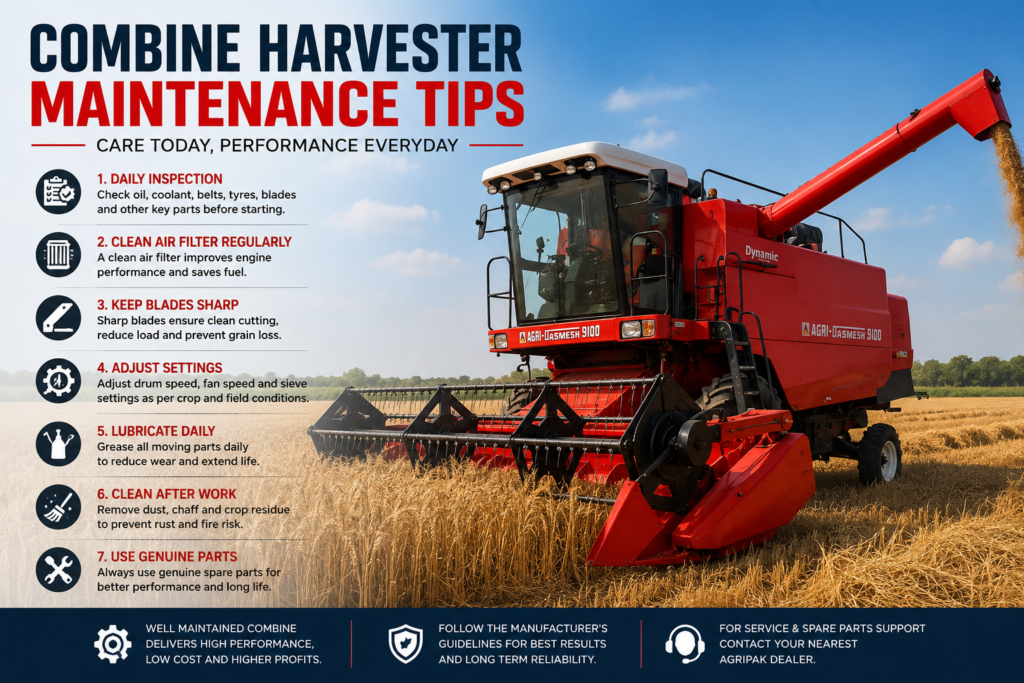
A combine harvester can save time, reduce labour cost, and speed up harvesting. But to get the best result, farmers must use and maintain it correctly.
A combine works hard in dusty fields, heavy crop conditions, and long harvesting hours. Small negligence can lead to grain loss, breakdown, fuel waste, and expensive repairs.
That is why manufacturers and suppliers should educate farmers with these important tips.
1. Check the Machine Before Every Harvesting Day
Before starting work, the operator should do a basic inspection.
Check:
- Engine oil level
- Coolant level
- Hydraulic oil level
- Fuel level
- Air filter condition
- Belts and chains
- Tyre pressure or track condition
- Cutter bar and blades
- Nuts, bolts, and guards
2. Clean the Air Filter Regularly
Combine harvesters work in very dusty fields. Dust can block the air filter quickly.
A blocked air filter can cause:
- Low engine power
- More fuel consumption
- Engine overheating
- Black smoke
- Poor machine performance
Farmers should clean the air filter daily during harvesting season. If the filter is damaged or too dirty, it should be replaced.
Never run the machine without an air filter.
That is a shortcut to engine damage.
3. Keep Blades and Cutter Bar Sharp
The cutter bar is the first contact point with the crop.
If the blades are dull or damaged, the machine will not cut properly. This can increase fuel use and reduce harvesting speed.
Farmers should check:
- Knife sections
- Guards
- Fingers
- Reel position
- Cutter bar alignment
Sharp blades mean clean cutting.
Clean cutting means faster harvesting.
4. Adjust the Machine According to the Crop
One setting does not suit every crop.
Wheat, rice, maize, soybean, and other crops need different settings. The operator should adjust the combine based on crop type, moisture level, and field condition.
Important adjustments include:
- Header height
- Reel speed
- Threshing drum speed
- Concave clearance
- Fan speed
- Sieve opening
- Ground speed
Wrong settings can cause grain loss, broken grains, and poor cleaning.
A combine is powerful.
But correct setting makes it smart.
5. Avoid Overloading the Machine
Many farmers try to harvest too fast. But pushing the machine beyond its capacity can damage parts and increase grain loss.
Overloading can cause:
- Belt slipping
- Blockage
- Poor threshing
- Engine strain
- High fuel consumption
- Early wear of parts
The operator should maintain a steady speed based on crop density.
Fast is good.
But controlled speed is better.
6. Watch for Grain Loss During Harvesting
Farmers should not wait until the field is finished to check grain loss.
They should stop the machine during work and check the ground behind the combine.
Grain loss may happen due to:
- Wrong drum speed
- Wrong sieve setting
- High travel speed
- Damaged blades
- Poor header adjustment
- Improper fan speed
Small grain loss may look normal.
But across a large field, it becomes big money loss.
7. Lubricate Moving Parts Daily
A combine has many moving parts. Chains, bearings, pulleys, shafts, and joints need proper lubrication.
Daily greasing helps to:
- Reduce friction
- Prevent overheating
- Extend part life
- Avoid sudden breakdown
- Improve machine performance
Farmers should follow the lubrication chart given by the manufacturer.
No grease means more wear.
More wear means more repair cost.
8. Check Belts and Chains
Belts and chains work continuously during harvesting.
Loose belts can slip. Tight belts can damage bearings. Dry chains can wear quickly.
Farmers should check:
- Belt tension
- Chain tension
- Cracks
- Wear marks
- Alignment
- Missing links
- Unusual noise
Replace damaged belts and chains before they fail in the field.
Field breakdown is always more expensive than workshop maintenance.
9. Keep the Radiator Clean
Dust, straw, and chaff can block the radiator screen.
When airflow is blocked, the engine may overheat.
Farmers should clean the radiator screen regularly during harvesting, especially in dry and dusty conditions.
Never ignore temperature warning signs.
Overheating can damage the engine badly.
10. Use Genuine Spare Parts
Cheap spare parts may look like a saving.
But they can reduce machine life and increase breakdown risk.
Farmers should use genuine or quality-approved spare parts for:
- Filters
- Belts
- Chains
- Bearings
- Blades
- Guards
- Hydraulic parts
- Electrical parts
A combine harvester is a high-value machine.
It deserves reliable parts.
11. Train the Operator Properly
A good machine needs a good operator.
Many combine problems happen because of wrong operation, not because of machine quality.
Operators should know:
- How to start and stop the machine safely
- How to adjust crop settings
- How to check grain loss
- How to clean the machine
- How to identify warning signs
- How to avoid overloading
Training is not an extra cost.
It is protection for the machine.
12. Clean the Machine After Work
After harvesting, the machine should be cleaned properly.
Remove:
- Straw
- Dust
- Mud
- Chaff
- Crop residue
- Grain stuck inside the machine
Cleaning helps to prevent rust, fire risk, insects, and hidden damage.
A clean machine is easier to inspect and repair.
13. Store the Combine Properly After Season
After harvesting season, the combine should not be left in an open field.
Before storage:
- Wash and clean the machine
- Grease all required points
- Change or check oils if needed
- Remove crop residue
- Disconnect the battery
- Cover electrical parts
- Park on level ground
- Keep under shade or cover
- Protect tyres from long-term pressure damage
Proper storage keeps the machine ready for the next season.
14. Keep Basic Spare Parts Ready
During harvesting season, time is money.
Farmers should keep common spare parts ready, such as:
- Air filter
- Fuel filter
- Engine oil filter
- Belts
- Chains
- Bearings
- Blades
- Guards
- Bolts and nuts
- Grease
- Hydraulic hose
Waiting for small parts during harvest can stop the full operation.
That hurts.
15. Follow the Manufacturer’s Manual
Every combine model has its own maintenance schedule.
Farmers should follow the operator manual for:
- Oil change interval
- Filter replacement
- Greasing points
- Belt tension
- Crop settings
- Safety instructions
- Storage method
The manual is not just a book.
It is the machine’s health guide.
Final Advice for Farmers
A combine harvester gives the best result when it is maintained properly.
Daily inspection, correct adjustment, trained operation, and timely spare parts support can reduce grain loss, save fuel, avoid breakdowns, and increase machine life.
A well-maintained combine does not just harvest crops.
It protects profit.