
Heavy soil is where tractor marketing gets exposed fast. A nice paint job does not pull a plough through wet clay.
If your land is hard, compacted, sticky after rain, or difficult to open, then the comparison between MF 375 and MF 385 becomes very important. Both are popular tractor categories in African markets. Both are widely considered for mixed farming, tillage, and haulage. But for heavy soil, they do not play the same role.
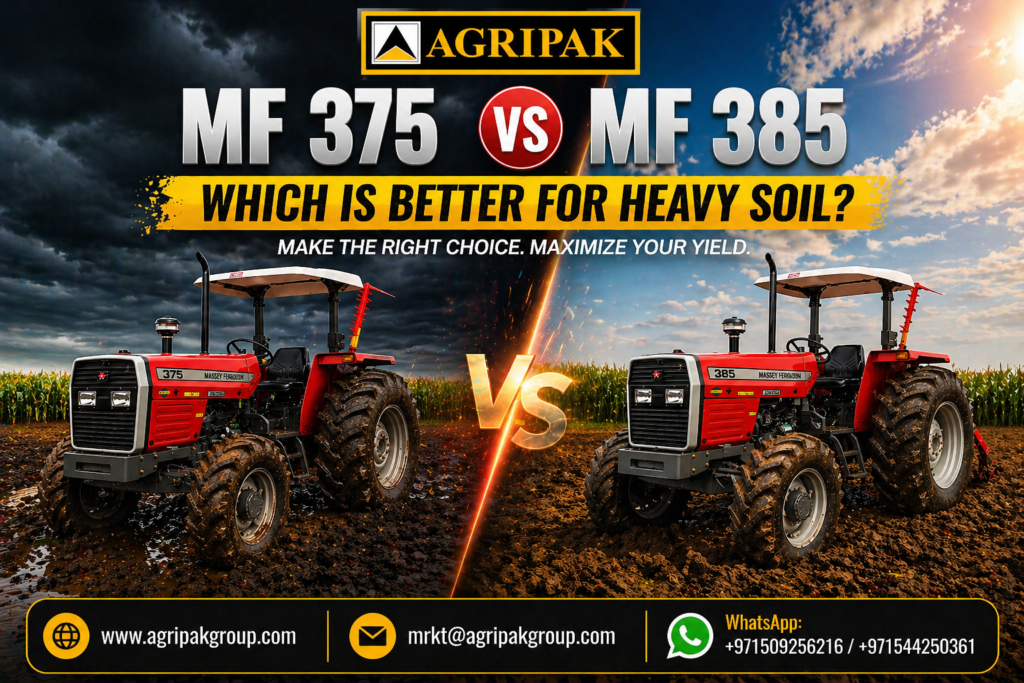
In simple terms, MF 385 is generally the better choice for heavy soil, especially when you need stronger pulling power, larger implements, or more consistent performance in tougher ground. MF 375 is still a solid and practical machine, but it is usually better for medium soil, moderate workloads, and farmers who want lower cost and simpler economics.
What “heavy soil” really means
Heavy soil usually means:
- clay-rich soil
- compacted ground
- land that becomes sticky in wet season
- fields that need stronger traction
- harder ploughing conditions
- more resistance against tillage tools
In these conditions, a tractor needs more than just engine power. It needs:
- good traction
- proper ballast and weight balance
- suitable implement match
- enough torque under load
- correct tire grip
- low wheel slip
This is why “which tractor is stronger?” is only part of the question. The better question is: which tractor stays effective in difficult field conditions without excessive slip, overload, or fuel waste?
Quick overview of MF 375 and MF 385
MF means Massey Ferguson, a widely known tractor line in many export markets.
In general field positioning:
- MF 375 sits in the lower power bracket compared to MF 385
- MF 385 offers more power and is commonly chosen for heavier work
That extra power matters in heavy soil. Not because bigger is always better, but because hard soil creates real draft load.
If the tractor is underpowered for the implement and soil condition, problems show up quickly:
- slow work rate
- high wheel slip
- incomplete depth
- overheating under strain
- more time and fuel spent per acre
Power, traction, and field behavior, Pulling ability
This is where MF 385 usually takes the lead.
In heavy soil, especially with ploughing and harrowing, the stronger tractor generally handles draft load better. It can maintain better working rhythm and is less likely to feel “stressed” when the implement bites into resistant ground.
MF 375 can still do the job in many cases, especially if:
- implement size is conservative
- working depth is moderate
- soil is only moderately heavy
- operator is patient and realistic
But if the soil is truly tough, MF 385 gives more reserve power.
Wheel slip
Heavy soil often causes traction loss. A tractor may have enough engine power, but if it cannot transfer that power to the ground, performance drops.
This is why 4WD matters even more in heavy soil. A smaller 4WD tractor can sometimes outperform a larger 2WD tractor in difficult field traction conditions.
Between MF 375 and MF 385, wheel slip depends on:
- tire condition
- ballast
- soil moisture
- 2WD or 4WD setup
- implement load
Still, the MF 385 usually has the advantage when conditions get more demanding.
Fuel use under load
This part is important. Many buyers assume the smaller tractor is always more economical. Not always.
In light work, yes, a smaller tractor often uses less fuel. But in heavy soil, an underpowered tractor may work longer, struggle more, and run inefficiently under constant load. That can reduce the expected savings.
A stronger tractor may use more fuel per hour, but if it completes the job faster and with less strain, the total field efficiency can actually be better.
Which tractor suits which implement size?
Implement matching decides half the story.
For heavy soil, farmers often want to use:
- stronger disc ploughs
- larger disc harrows
- deeper tillage tools
- trailers loaded with produce or inputs across difficult ground
MF 375 is generally better when the implement size is modest and correctly matched.
MF 385 is usually better when:
- the tillage tool is heavier
- deeper working depth is required
- the field is harder
- the operator wants more reserve power
- multiple operations must be done quickly within short planting windows
A tractor should not be judged alone. Tractor plus implement plus soil equals real performance.
2WD vs 4WD effect in heavy soil
This is a big one.
If your farm has real heavy soil, then traction can be as important as horsepower.
A 2WD tractor may be fine if:
- the ground is dry enough
- the field is mostly flat
- implement load is moderate
A 4WD tractor is better if:
- the land is slippery
- clay soil holds moisture
- there are slopes
- work must continue in less-than-perfect conditions
So the smarter question is not only MF 375 vs MF 385, but also:
- MF 375 2WD vs 4WD?
- MF 385 2WD vs 4WD?
- what implement will be used?
- what is the soil moisture at working time?
Real-life field scenarios
Scenario 1: Medium-heavy maize land, flat field, moderate implement
MF 375 may be enough here. It can be the more economical choice if the farmer is not pushing very large implements.
Scenario 2: Hard clay soil, repeated deep tillage, larger disc plough
MF 385 is the safer choice. It has more working reserve and handles the field load better.
Scenario 3: Wet season work with traction issues
A 4WD setup becomes very valuable. In this case, traction can beat simple horsepower on paper.
Scenario 4: Mixed use farm with transport and moderate tillage
MF 375 may remain attractive if the goal is all-round affordability with sensible implement size.
So which is better?
For heavy soil, MF 385 is generally the better tractor. It is better suited to harder pulling work, larger tillage demand, and tougher field conditions.
Choose MF 375 if:
- your soil is medium to moderately heavy
- implements are not oversized
- budget control matters more
- you want simpler all-round use
Choose MF 385 if:
- soil is truly heavy
- you need stronger tillage performance
- you want better reserve power
- time windows for land preparation are tight
The honest answer is not that one is “good” and the other is “bad.” It is that MF 375 is practical, while MF 385 is stronger for tougher ground.
Recommended next step
Ask for a tractor recommendation based on your actual soil, implement width, and working depth. A correct tractor-implement match matters more than brochure horsepower.
D) Comparison Table
| Factor | MF 375 | MF 385 | Best For |
|---|---|---|---|
| Power reserve | Moderate | Higher | MF 385 for heavier work |
| Heavy soil tillage | Good with correct implement | Better overall | MF 385 |
| Fuel use in light work | Usually lower | Usually higher | MF 375 |
| Performance under high load | Acceptable | Stronger | MF 385 |
| Budget-friendliness | Better | Higher investment | MF 375 |
| Implement flexibility | Moderate | Higher | MF 385 |
| Medium soil farms | Very suitable | Also suitable | MF 375 value pick |
| Hard clay or compact soil | Can struggle if overloaded | More suitable | MF 385 |
| General mixed use | Good | Very good | Depends on budget |
| Best for… | Moderate conditions | Tougher soil and heavier tillage | Clear split by workload |
E) Buyer Checklist
- Is your soil medium or truly heavy clay?
- Do you plough deep or shallow?
- Are your fields flat or sloped?
- Is wheel slip a common problem?
- Which plough and harrow size will you use?
- Do you need 2WD or 4WD?
- Is budget a bigger concern than output speed?
- How many acres must be covered in a short time?
- Will the tractor also do transport work?
- Are spare parts available locally?
- Do you have an experienced operator?
- Will the machine work during or after rains?
- Do you need extra power for future expansion?
- Is the implement weight already confirmed?
- Have you matched tire setup and ballast needs?
F) FAQ Block
1. Which is better for heavy soil, MF 375 or MF 385?
MF 385 is generally better for heavy soil because it offers more power reserve for difficult tillage. MF 375 can still work well in moderate conditions with a proper implement match.
2. Is MF 375 enough for clay soil?
It can be, but it depends on the severity of the soil and the implement used. In very hard or sticky soil, it may feel limited.
3. Does more horsepower always mean better performance?
Not always. Traction, implement match, operator skill, and soil moisture also affect field performance.
4. Is 4WD important for heavy soil?
Yes, often. 4WD improves traction and can reduce wheel slip in difficult field conditions.
5. Which tractor is more economical?
MF 375 may be cheaper to own and operate in lighter work. But in heavy soil, MF 385 may work more efficiently if the smaller tractor struggles.
6. Can MF 385 use larger implements?
Generally yes. It is better suited for stronger or larger tillage tools than MF 375.
7. Which is better for mixed farming?
Both can suit mixed farming. MF 375 fits more budget-sensitive operations, while MF 385 gives more performance margin.
8. Which is better for maize and sunflower fields with hard ground?
MF 385 is usually the better choice for harder conditions and time-sensitive land preparation.
9. Will MF 375 save fuel?
It may save fuel in lighter work. In very heavy soil, total efficiency depends on how hard the tractor must struggle.
10. What should I compare before buying?
Compare soil type, acreage, implement size, terrain, season of operation, spare parts, and operator skill.
G) Trust Signals
Assumptions & limits
This comparison is based on typical field behavior in African export-market usage, not one exact factory spec sheet. Actual performance varies by tire size, ballast, engine condition, drivetrain type, and implement match. No fake pricing is used.
Safety notes
Do not overload the tractor with oversized tillage tools. Heavy soil increases draft force, so hitching, ballast, and braking must be handled carefully.
Maintenance tips
Inspect tires for wear, keep air filters clean in dusty land prep, monitor coolant under heavy work, and service transmission and hydraulic systems on schedule. In hard ground, small maintenance neglect becomes expensive quickly.