
A lot of farmers think bigger tractor means better farming. Not always. Sometimes bigger tractor just means bigger fuel bill, more weight, and more money sleeping in the shed.
For a 5-acre maize farm in Tanzania, the best tractor is usually a simple, reliable 2-wheel drive tractor in the 45–60 horsepower range, especially if the land is fairly flat, the soil is medium, and the farmer wants to use the machine for more than one job. If the land is wetter, heavier, or sloped, a small 4-wheel drive model may be smarter.
The right tractor for 5 acres is not the one with the biggest engine. It is the one that can do the job well, match local implements, stay affordable to maintain, and work through the season without drama.
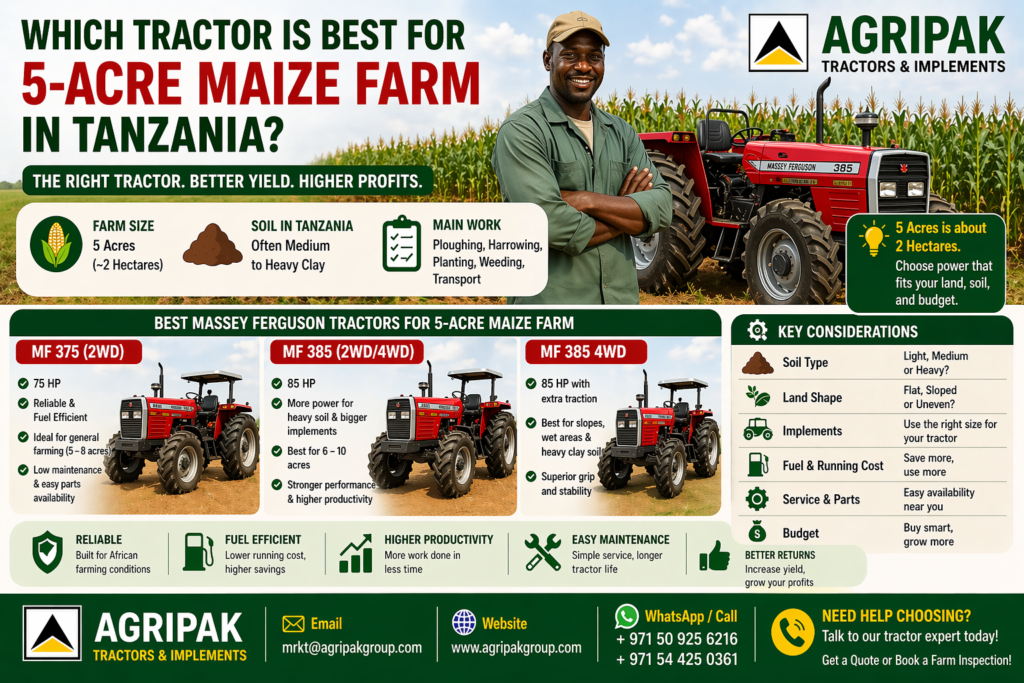
Which Tractor Is Best for a 5-Acre Maize Farm in Tanzania?
A lot of farmers think bigger tractor means better farming. Not always. Sometimes bigger tractor just means bigger fuel bill, more weight, and more money sleeping in the shed.
For a 5-acre maize farm in Tanzania, the best tractor is usually a simple, reliable 2-wheel drive tractor in the 45–60 horsepower range, especially if the land is fairly flat, the soil is medium, and the farmer wants to use the machine for more than one job. If the land is wetter, heavier, or sloped, a small 4-wheel drive model may be smarter.
The right tractor for 5 acres is not the one with the biggest engine. It is the one that can do the job well, match local implements, stay affordable to maintain, and work through the season without drama.
Why tractor choice matters on a 5-acre maize farm
Five acres is not a huge farm. That matters.
On a small maize farm, the real challenge is not “how to use maximum horsepower.” The challenge is how to get the work done on time without overspending. In maize farming, timing is everything. If ploughing is late, planting is late. If planting is late, yield suffers. Rain does not wait because the tractor dealer gave you a nice brochure.
That is why tractor selection should focus on:
- timely land preparation
- ease of operation
- implement availability
- fuel use
- repair simplicity
- resale value
- ability to also do transport and general farm work
A 5-acre farmer often needs one tractor to do many jobs. Ploughing. Harrowing. Ridging in some areas. Trailer transport. Sometimes pumping, spraying support, or post-harvest haulage. So versatility matters more than raw power.
What work the tractor must actually do
Before choosing a tractor, first list the real jobs.
Land preparation
For maize, the main jobs are usually:
- primary tillage with disc plough or mouldboard plough
- secondary tillage with disc harrow
- seedbed preparation
- sometimes ridging, depending on local practice
If the soil is light to medium, a 45–50 HP tractor can often handle the work for 5 acres without trouble. If the soil is heavier, sticky after rain, or compacted from years of use, 50–60 HP gives a better margin.
Planting support
Some farmers still plant manually even if they own a tractor. Others want the tractor to pull a planter. If the goal is mechanized planting later, it is smart to buy a tractor that can handle both current needs and near-future upgrades.
For most 5-acre maize farms, the tractor should comfortably run:
- small mechanical planter
- light cultivator
- trailer for seed and fertilizer movement
Spraying and transport
This is where many farmers underestimate the value of a tractor. A tractor is not only for ploughing week. It is useful across the season.
A properly matched tractor can also:
- pull a trailer with harvested maize
- move fertilizer bags
- support irrigation and haulage needs
- reduce labour pressure during peak season
Seasonal use vs year-round use
If the tractor will only work a few days each season, then cost control is critical. But if the farmer also does transport, hires out the tractor, or farms multiple plots, spending a little more for better flexibility may be worth it.
Best tractor horsepower range for 5 acres
When 35–50 HP is enough
A 35–50 HP tractor is often enough when:
- the land is flat
- the soil is sandy or medium
- the farm is only 5 acres
- implements are small
- the tractor is used mainly for ploughing, harrowing, and transport
This range is attractive because it is usually:
- cheaper to buy
- lighter on fuel
- easier to maintain
- easier to find basic parts for in many markets
For a very small maize farmer, this is often the sweet spot.
When 50–60 HP makes more sense
A 50–60 HP tractor is better when:
- the soil is heavier
- the area gets wet during the season
- the farmer wants to use a stronger disc harrow
- the land includes slope or hard ground
- the tractor may later serve more land than the current 5 acres
This range gives more breathing space. Not crazy big. Just more capable.
For example, if a farmer currently has 5 acres but plans to grow to 8 or 10 acres, buying slightly above today’s need can save money later.
Why bigger is not always better
A tractor that is too large for a 5-acre farm can create problems:
- higher purchase cost
- higher fuel consumption
- heavier compaction on soft soil
- harder implement matching
- wasted capacity
Buying an 85 HP tractor just to farm 5 acres of maize on medium soil is like bringing a buffalo to carry a school bag. It can do it. But come on.
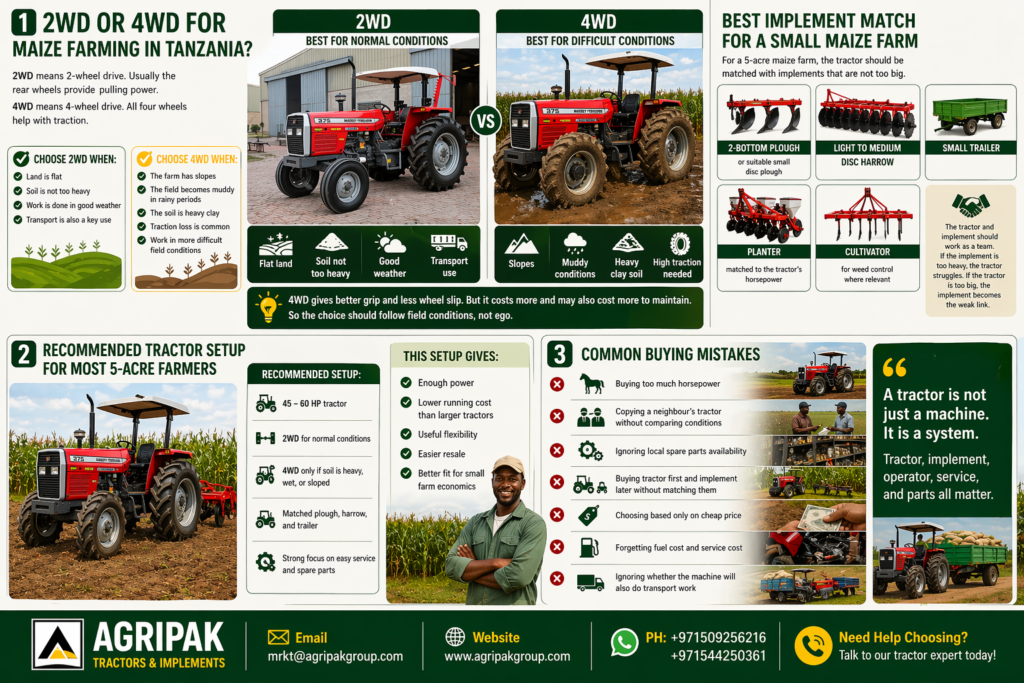
2WD or 4WD for maize farming in Tanzania?
2WD means 2-wheel drive. Usually the rear wheels provide pulling power.
4WD means 4-wheel drive. All four wheels help with traction.
For most 5-acre maize farms in Tanzania, 2WD is usually enough if:
- land is flat
- soil is not too heavy
- work is done in good weather
- transport is also a key use
Choose 4WD when:
- the farm has slopes
- the field becomes muddy in rainy periods
- the soil is heavy clay
- traction loss is common
- the tractor must work in more difficult field conditions
4WD gives better grip and less wheel slip. But it costs more and may also cost more to maintain. So the choice should follow field conditions, not ego.
Best implement match for a small maize farm
For a 5-acre maize farm, the tractor should be matched with implements that are not too big.
Typical sensible combinations include:
- 2-bottom plough or suitable small disc plough
- light to medium disc harrow
- small trailer
- planter matched to the tractor’s horsepower
- cultivator for weed control where relevant
The tractor and implement should work as a team. If the implement is too heavy, the tractor struggles. If the tractor is too big, the implement becomes the weak link.
Recommended tractor setup for most 5-acre farmers
For most small maize farmers in Tanzania, the most balanced choice is:
Recommended setup:
- 45–60 HP tractor
- 2WD for normal conditions
- 4WD only if soil is heavy, wet, or sloped
- matched plough, harrow, and trailer
- strong focus on easy service and spare parts
This setup gives:
- enough power
- lower running cost than larger tractors
- useful flexibility
- easier resale
- better fit for small farm economics
Common buying mistakes
The biggest mistakes are usually simple:
- buying too much horsepower
- copying a neighbour’s tractor without comparing conditions
- ignoring local spare parts availability
- buying tractor first and implement later without matching them
- choosing based only on cheap price
- forgetting fuel cost and service cost
- ignoring whether the machine will also do transport work
A tractor is not just a machine. It is a system. Tractor, implement, operator, service, and parts all matter.
Final recommendation
So, which tractor is best for a 5-acre maize farm in Tanzania?
For most farmers, the best choice is a reliable 45–60 HP tractor, usually 2WD, with easy spare parts access and correctly matched implements. If the field has heavy soil, slope, or wet conditions, then moving to 4WD is a smart step.
Do not buy based on horsepower alone. Buy based on:
- soil type
- terrain
- future farm expansion
- implement availability
- repair support in your area
A smaller, reliable tractor that works every season is better than a bigger one that becomes a wallet workout.
Recommended next step
Before buying, list your acreage, soil type, slope, main jobs, and implement needs. Then ask for a tractor-and-implement match, not just a tractor quote.
D) Comparison Table
| Option | Power Range | Best Field Condition | Main Advantage | Main Trade-Off | Best For |
|---|---|---|---|---|---|
| Small utility tractor | 35–45 HP | Light soil, flat land | Lower cost, lower fuel use | Limited for tougher work | Very small farms, light tillage |
| Mid-range tractor | 45–60 HP | Light to medium soil | Best balance for 5 acres | Slightly higher cost | Most maize farmers in Tanzania |
| Larger tractor | 70+ HP | Heavy work, expansion plans | More pulling power | Higher cost and overcapacity | Bigger farms or contract work |
| 2WD tractor | Any | Flat, dry to moderate fields | Simpler, more affordable | Less traction in difficult fields | General use and transport |
| 4WD tractor | Any | Heavy, wet, sloped fields | Better traction and field performance | Higher purchase and maintenance cost | Tougher field conditions |
E) Buyer Checklist
- What is your exact farm size today?
- Will the farm increase in the next 2–3 years?
- Is the soil sandy, loamy, or heavy clay?
- Does the field stay wet in rainy season?
- Is the land flat or sloped?
- Do you need the tractor mainly for ploughing or also for transport?
- Which implements will you use first?
- Are those implements locally available?
- Do spare parts exist in your area?
- Who will service the tractor?
- How far is the nearest mechanic or dealer?
- What is your total budget, including implements?
- Can the tractor also earn income through hire work?
- Is fuel efficiency important for your operation?
- Do you want simple mechanics or more traction performance?
F) FAQ Block
1. What size tractor is enough for 5 acres of maize?
For most farms, a 45–60 HP tractor is enough. It gives a good balance of power, fuel economy, and usefulness for ploughing, harrowing, and transport.
2. Is 50 HP enough for maize farming in Tanzania?
Yes, in many cases 50 HP is enough for 5 acres, especially on flat land with light to medium soil. It may be less ideal for very heavy soil or muddy conditions.
3. Do I need 4WD for a 5-acre maize farm?
Not always. 4WD is best when the soil is heavy, the land is sloped, or the field gets slippery in the wet season.
4. Can a small tractor also do transport work?
Yes. A properly matched small or mid-range tractor can pull a trailer for farm transport, which adds value beyond field work.
5. Is a bigger tractor better for future expansion?
Sometimes, but not always. Buying slightly above current need can help future growth, but buying too large can increase costs without real benefit.
6. Which is better for small farms: low cost or higher horsepower?
Usually the better choice is the tractor that fits the farm system, not the one with the biggest engine. Reliability, service, and implement matching matter more.
7. What is the biggest mistake when choosing a tractor?
A common mistake is choosing by price or horsepower only. Farmers should also check soil type, implement size, spare parts, and service support.
8. Is 2WD enough for Tanzania farms?
For many farms, yes. 2WD works well on flat and moderate ground, especially where transport use is important.
9. Can I use one tractor for maize and other crops?
Yes. A versatile 45–60 HP tractor can often support mixed farming, transport, and general field operations.
10. Should I buy tractor first or implements first?
You should plan both together. A good tractor with badly matched implements will still perform poorly.
G) Trust Signals
Assumptions & limits
This guidance assumes a typical small maize farm in Tanzania with common field operations such as ploughing, harrowing, and transport. Exact tractor choice depends on soil condition, rainfall pattern, terrain, implement weight, and service access. No prices are included because pricing changes by model, country, shipping, and specification.
Safety notes
Never overload the tractor with oversized implements. Use rollover protection where applicable, avoid working across steep slopes without proper caution, and keep bystanders away during PTO or hitch operations.
Maintenance tips
Check engine oil, coolant, air filter, tire pressure, and hydraulic leaks before use. Clean the radiator often in dusty conditions, grease moving points regularly, and service the tractor on schedule before peak season.
Send us your land details on WhatsApp—we’ll suggest the exact tractor and implement setup